
Scott System
Scott System
Case Study

Scott System partnered with Capasso Enterprises Inc. to provide cast-in-place foam formwork to build an architecturally unique staircase for Amherst College. The project demanded a level of dimensional accuracy and surface consistency that traditional forming methods simply cannot deliver. By combining CAD engineering with 5-axis CNC milling, Scott System developed a custom forming solution that made a difficult pour easily achievable.

A doubly curved spiral staircase presents forming challenges on every axis simultaneously. The geometry curves in two directions at once, meaning no single surface is plumb, level, or straight. Traditional wood or steel formwork struggles to conform to that kind of compound curvature without labor-intensive site modifications, significant material waste, and compromised dimensional accuracy.
For this cast-in-place application, the formwork had to define the final concrete geometry precisely. Any deviation during forming would translate directly into the finished structure. The team needed a solution that could handle the complexity of the geometry, reduce installation difficulty in the field, and make the most efficient use of material.

The goal was straightforward: produce a finished concrete staircase that honors the full sculptural intent of the design without sacrificing structural reliability or construction efficiency. For that to happen, the formwork itself had to be engineered, not improvised.
Capasso Enterprises needed a forming partner with the digital fabrication capabilities to translate the staircase’s compound curves from a design model into production-ready components. The vision demanded precision at every stage, from the first CAD file to the final pour.
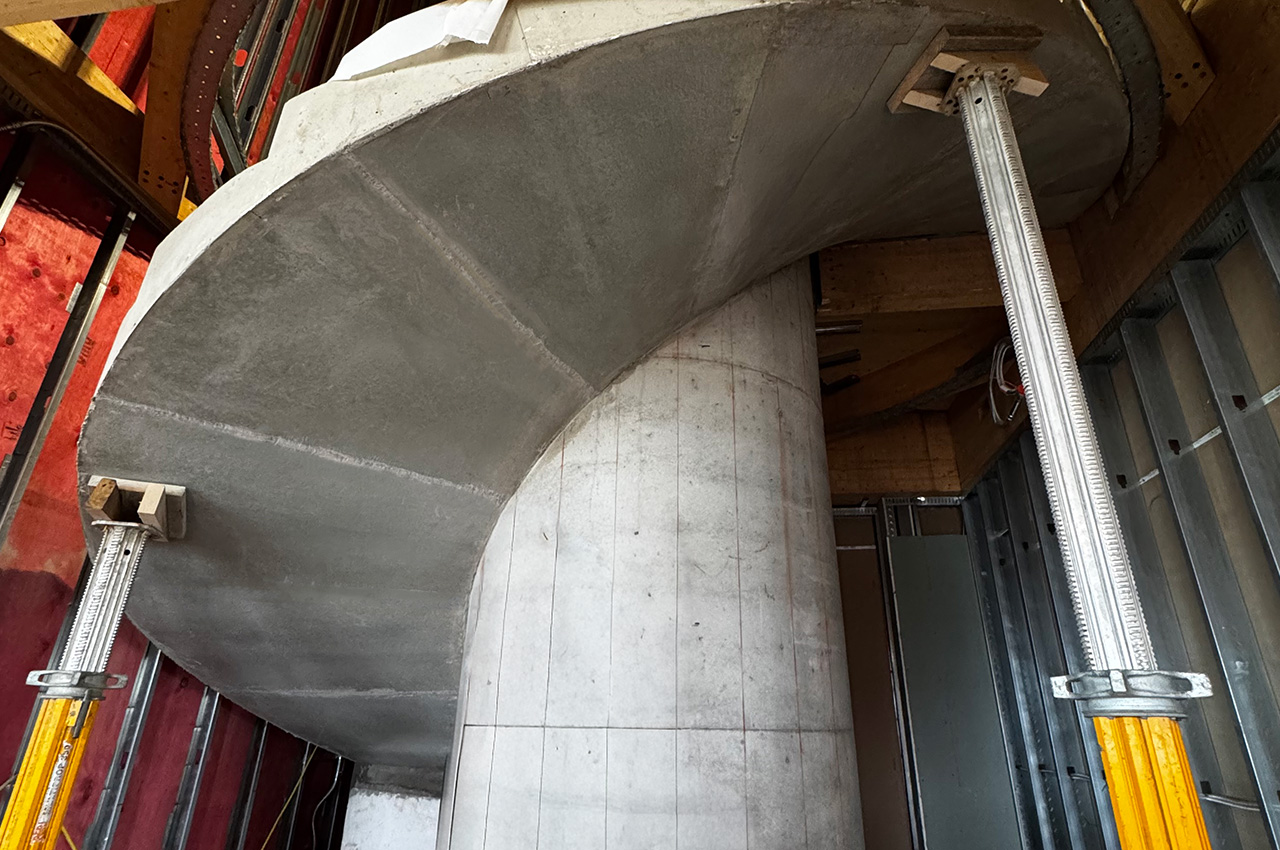
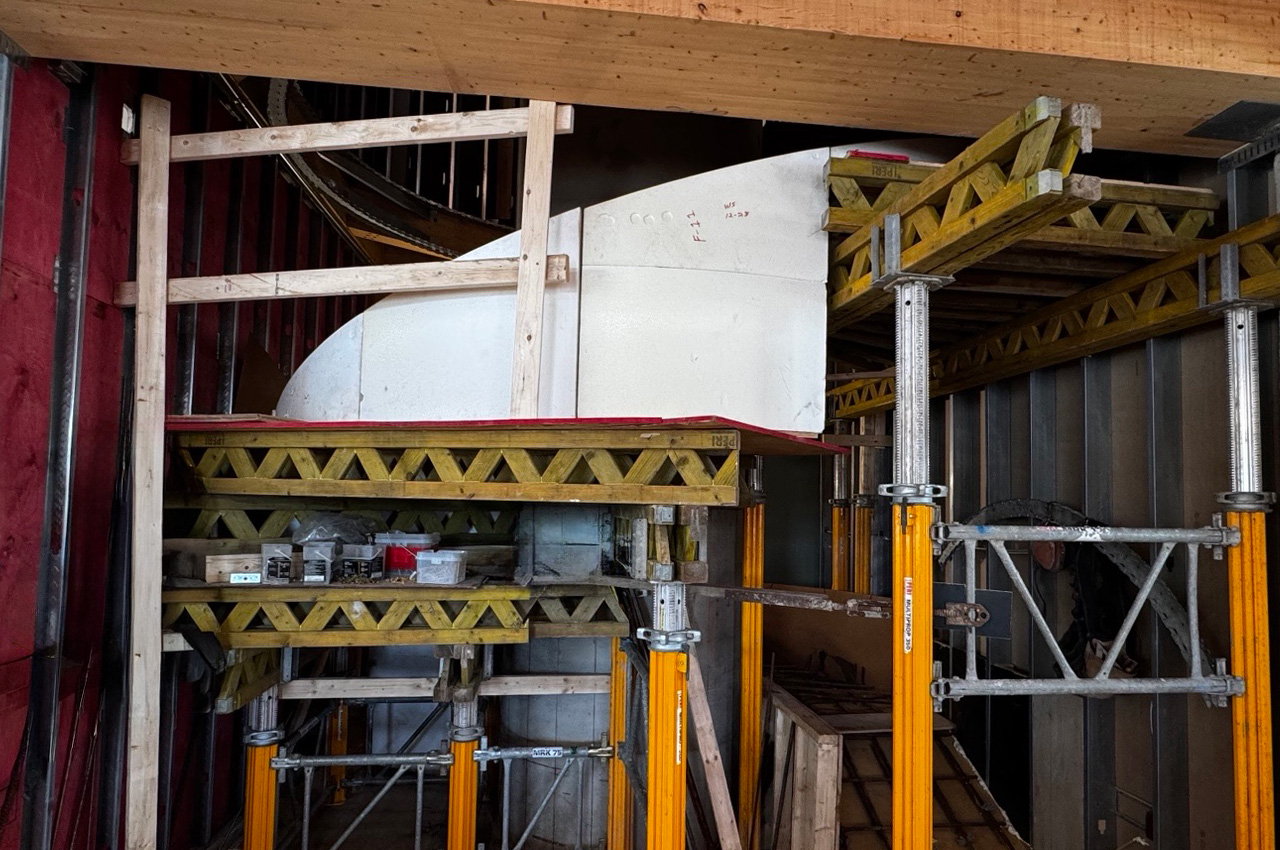
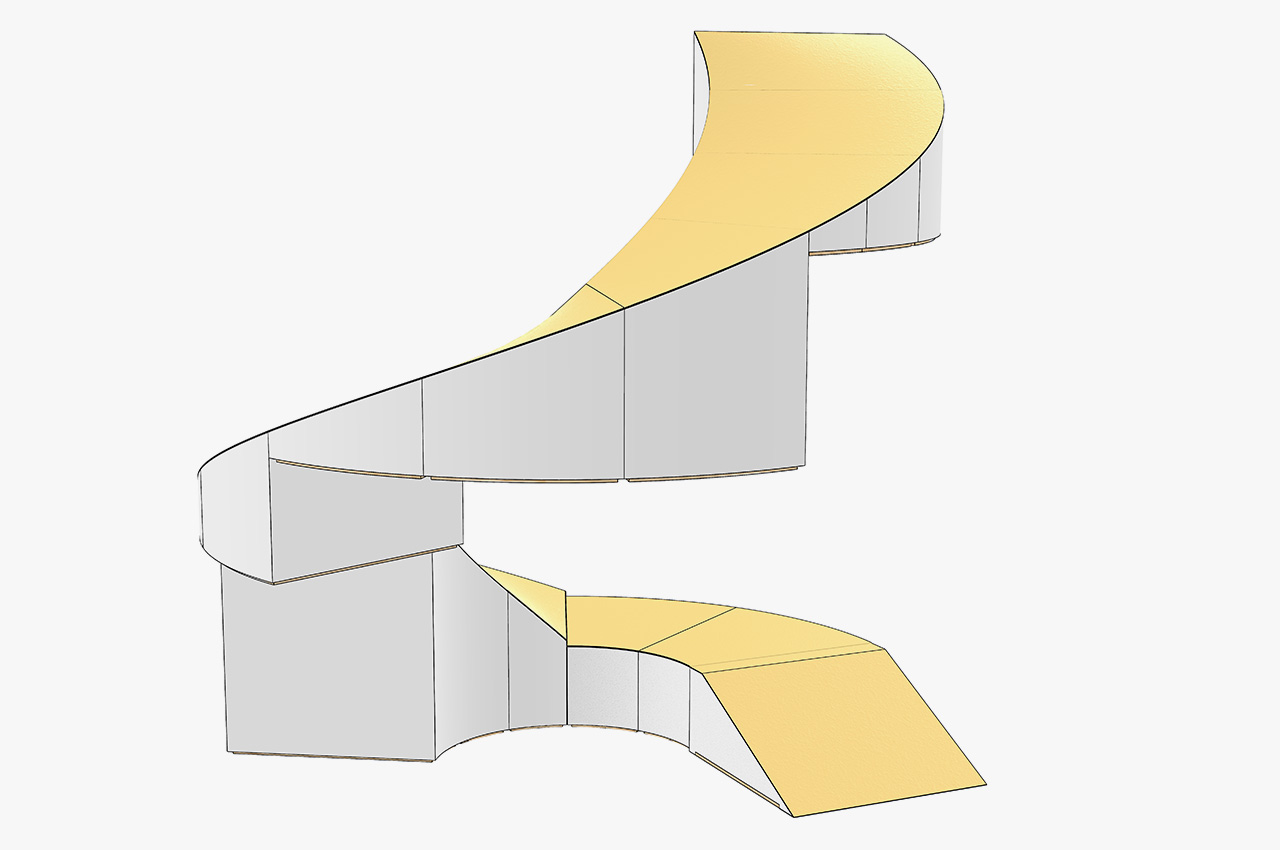

Scott System engineered the foam formwork for the staircase entirely in CAD, developing the geometry digitally before a single piece was cut. That digital-first approach allowed the team to resolve complex surface transitions in the model and output toolpaths directly to a 5-axis CNC machine.
Working with UFP Concrete Forming Solutions, the team developed a stepped design for the formwork components. This delivered three key advantages: easier installation in the field, better material yield during fabrication, and superior dimensional accuracy in the finished concrete. The result was a formwork system purpose-built for the staircase’s geometry and UFP’s Shoring Solution.
CAD Engineering: The staircase geometry was fully modeled before fabrication began. Engineering the doubly curved surfaces in CAD allowed the team to verify fit and geometry digitally, reducing costly corrections in the field.
5-Axis CNC Milling: 5-axis machining made it possible to cut complex, compound-curved foam components in a single setup. That capability is what separates this kind of custom formwork from anything achievable with conventional cutting methods.
Stepped Component Design: Developed in collaboration with UFP Concrete Forming Solutions, the stepped design simplified installation for Capasso Enterprises, improved how material was allocated across each component, and tightened dimensional accuracy across the full staircase.
Partnership with Capasso Enterprises Inc.: A close working relationship with the contractor ensured that the formwork system fit the project’s installation sequence and field conditions. Coordination between Scott System’s engineering team and Capasso’s crew was essential to delivering a solution that worked as designed.

Cast-in-place EPS foam formwork
5-axis CNC milled foam components
Stepped shoring design developed with UFP Concrete Forming Solutions
The completed formwork system enabled a doubly curved, sweeping spiral staircase at Amherst College. The stepped component design performed as intended in the field, making installation more manageable while holding tight dimensional tolerances throughout the pour. By developing the forming solution in CAD and machining it on a 5-axis CNC, Scott System eliminated the guesswork that typically accompanies compound-curved concrete work and delivered a finished result that matched the design intent precisely.